*Click Here for Day #2 of our New Year’s Road Trip in Japan.
We got up around 7:00 in the morning. We got dressed in our yukata and donned the special overcoats that Sennen no Yu Gonzaemon provided. After, we headed over to Ichinoyu which was one of Kinosaki Onsen’s seven famous onsen. It’s a short one minute walk across a bridge.
Kinosaki Onsen


When we entered, we put our shoes into some cubies and scanned the QR code on the special onsen pass we had received from the ryokan. Each pass gave us free entry to all of Kinosaki Onsen’s famous onsen. After entering the gender separate bathing facilities, we got washed up. The notable feature of Ichinoyu is the outside bath that resembles a cave. We would have liked to have tried a couple of the other onsens, but we were short on time. In the future, we could easily see ourselves spending a whole day exploring Kinosaki Onsen.

On our way back to the ryokan, we stopped by this public onsen fountain. We tried a small sip. The smell and taste were quite pungent. It’s not particularly enjoyable. We got back to our room and changed real quick. Check out went smoothly and were able to head out by 9:00.
Our first stop of the day was the Tottori Sand Dunes. It was an hour and a half drive from Kinosaki Onsen. We took our time on the side roads as they still had a thin layer of snow and ice on them. We were able to pick up our speed once we hit the main roads that had been freshly cleared.

The drive brought us along the coast and we stopped at a dedicated viewing spot to take some pictures. It was quite beautiful to see the waves crash against the shoreline. It may have also seemed more harsh since it was cloudy, cold, super windy, and there was snow everywhere.
Tottori Sand Dunes Visitor Center


We got back in the car and continued on. We arrived at the Tottori Sand Dunes a short time later. It was snowing gently as we got in. We paid ¥500 to park in their dedicated parking lot. We were one of only a couple cars in the lot. Unfortunately, since it was snowing/raining we were unable to see Tottori Sand Dunes’ famous ripples. We were told that the day before had been a good day to view them. We entered the Tottori Sand Dunes Visitor Center and were impressed with the amount of information they had.


They were holding a special pine cone Christmas tree making workshop that they enthusiastically wanted us to participate in. Using a hot glue gun, we decorated our pine cones with various craft items, pieces of recycled materials including glass shards and beads as well as some sea shells. It was fun. We saw this nice display that showed how local junior high school students were cleaning up the beaches while repurposing what they found and making it into art.

Since the conditions outside were so poor, the staff offered to show us how the ripples in the sand were formed. We were taken to a separate room and given a live and interactive presentation on the science behind the sand dunes ripples and some of its most prominent features. We learned a lot and the presenter was super energetic despite us being the only two participants.
Tottori Sand Dunes

We decided to take a quick peak and see how sand dunes looked with snow on them. The area was super windy. We crested a series of stair cases and were blasted with a strong gust of wind. It was so windy that at times we had trouble maintaining our balance. In addition, we were being pelted with a fine amount of sand, which made visibility difficult. We decided to not go any further. We snapped some pictures before heading back.
The Sand Museum

After our brief look at the sand dunes, we decided to head over to The Sand Museum. It was a short six minute walk down the street. We had to watch our step as there was residual snow and ice still on the ground. The entrance fee was a reasonable ¥800/person. We were given tickets and a brochure in English. It was here that we learned that Egypt was the theme of the current exhibit.


The main hall is where the main sand sculptures are. The vaulted ceilings of the main hall really gave scale and provided a sense of depth to each of the works. The scale and detail of the different works was incredible. It was amazing to see how the sand sculptors were able to manipulate the sand and create such life like scenes. Each of the exhibits represented a specific scene from ancient up until colonial Egypt. Some of the exhibits looked so real that we couldn’t believe they were made of sand.


It was neat to see all the different artists from all over the world, that helped create these amazing sand sculptures. We learned later that the theme and exhibition of the Sand Museum changes every year. We went upstairs where they had posters that showed the works of previous years. The Sand Museum was definitely a place you could come back to year after year.


Throughout the museum and some of the surrounding buildings, there were a number of these super cute little sand figures. They also had this special Pokemon manhole cover on the main street by The Sand Museum.
Murakami Fisheries


We wrapped up at the Tottori Sand Museum and made our way back to our car at the Tottori Sand Dunes Visitor Center. Along the way back, we stopped and has a delicious sashimi bowls for lunch at Murakami Fisheries. We also made a quick stop at Totto Purin. We saw their sign on the sidewalk and wanted to try their signature “sand pudding”. There was a special promotion for three, so decided to make it a trio. We got their sand pudding, seasonal persimmon pudding as well as their original pudding.
Roadside Station Kirara-Taki


We were running a little short on time, so we decided to forgo a trip to Izumo Taisha. We were a little bummed, but it gave us a reason to return to the area in the future. After driving for about 2 hours and 30 minutes we stopped for dinner at Roadside Station Kirara-Taki. We had a delicious meal and were able to watch the sunset.
Yunotsu Onsen
We got back on the road and drove for a little under an hour before we reached our destination for the night. Yunotsu Onsen was a small rural onsen village located on the coast. In the past, the port was used to transport silver that had been mined in the local mountains. The main street running through town is in the shape of a “V” and wraps around a large hill. The streets were pretty narrow and we had to pull over a couple times to let cars pass. The town was pretty small, but we could definitely see signs of revitalization and development. There were a number of buildings that were under construction.

Our lodging for the night was the Ebisu unit at Travel Inn Kiunso. When we arrived, we parked in front and got checked in. We received our travel vouchers and made sure to reserve seats for the Kagura performance at Tatsunogozen Shrine. Afterwards, we got bags of towels and yukata to take with us. We were staying in a private house that was down the street. It had a self check in policy, so we turned the car around and headed over.
The show started at 20:00 so we got settled into our place and changed into some warm clothes. The walk to Tatsunogozen Shrine was only three minutes away.
Kagura Performance

When we arrived at the shrine, they had a reception table set up. The ryokan must have called in a reservation on our behalf as our names were on a reservation list. The cost of the tickets was ¥2,000/person. We used our two coupons worth ¥1,000 and paid the difference in cash. Next, we were given plastic bags to put our shoes in. We then headed up the stairs to the main building. At the top an attendant showed us to our seats. There were a couple dozen low chairs and sitting cushions.


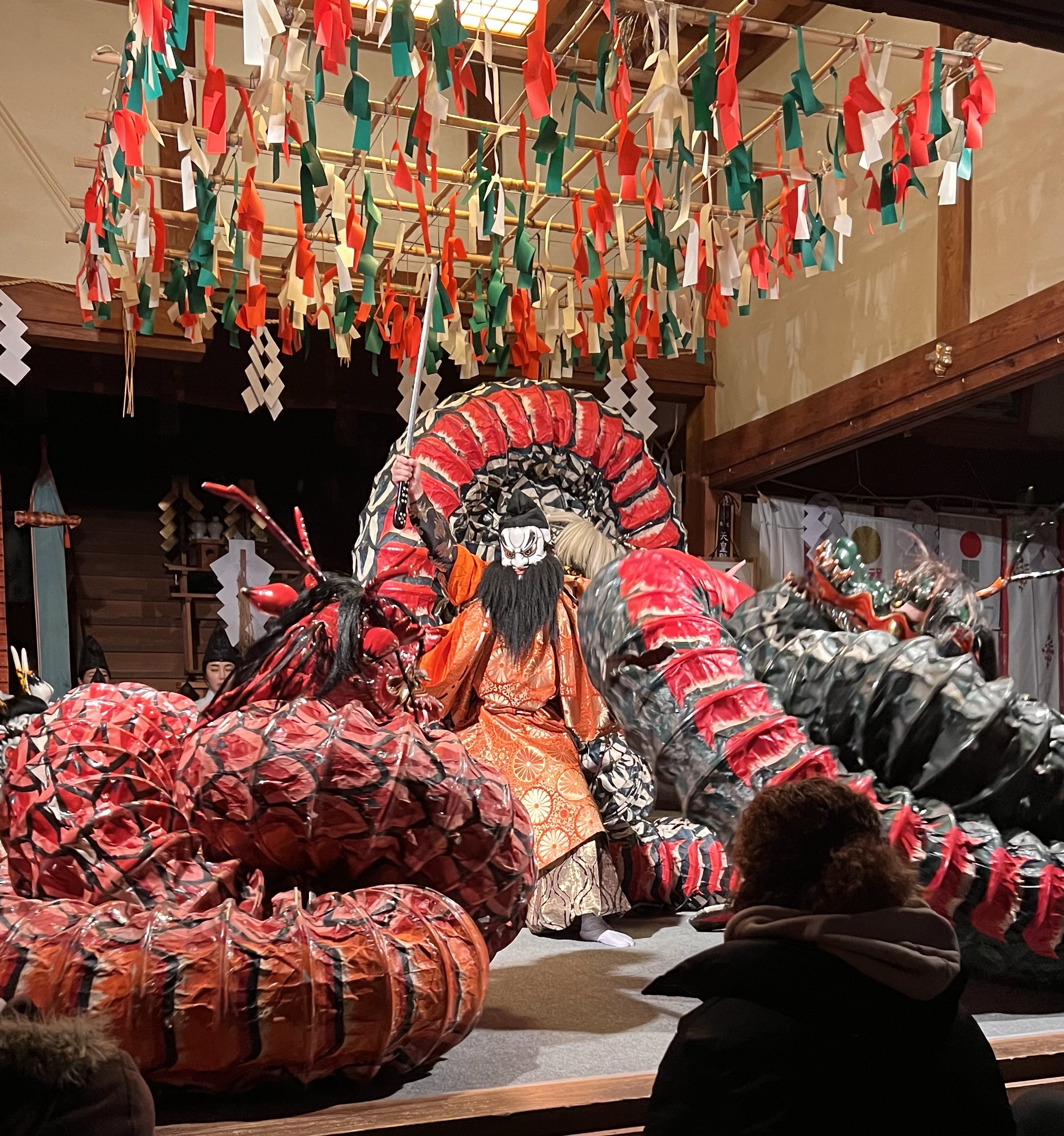
The show has several different parts. Each of the parts told a short story. The first scene was a showdown between two warriors, the second was a battle between a warrior and a demon, and the third was about fishing. The last scene culminated with the hero defeating five dragons and rescuing the princess. In between the stories, their was a brief description in Japanese and a short music break. We really enjoyed the Kagura performance. The colorful costumes and masks were extremely elaborate and detailed.


At the end of the performance, we were allowed to go on the stage and hold the dragon masks. We were surprised with how heavy and sturdy they were.
During the performances there was a small group of performers in the back who provided live music throughout the show. Some of them were really young, probably young elementary school age. It was nice to see that the town was trying to pass on the traditions of the Kagura performance to the next generation.
We later learned that Kagura performances were one of the oldest types of traditional Japanese entertainment, dating back to around 800 AD. Making it significantly older than kabuki and noh. We also found out that the Kagura performance we saw at Tatsunogozen Shrine was one of only a few that are still regularly performed in all of Japan.
Final Thoughts
Wow! Day #3 of our New Year’s Road Trip in Japan was another action packed day. We were a little bummed about not being able to see the ripples at the Sand Dunes, but The Sand Museum made the stop memorable and worthwhile. Next time, we’d like to take things a little slower and explore the city of Matsue and the Izumo Shrine area. At first, we were a little apprehensive about paying ¥2,000 per person for tickets to the Kagura performance. However, after seeing it we thought it was well worth it. We would highly recommend seeing it if your in Yunotsu on a Saturday night.
More to Come…
*Click Here for Day #4 of our New Year’s Road Trip in Japan.