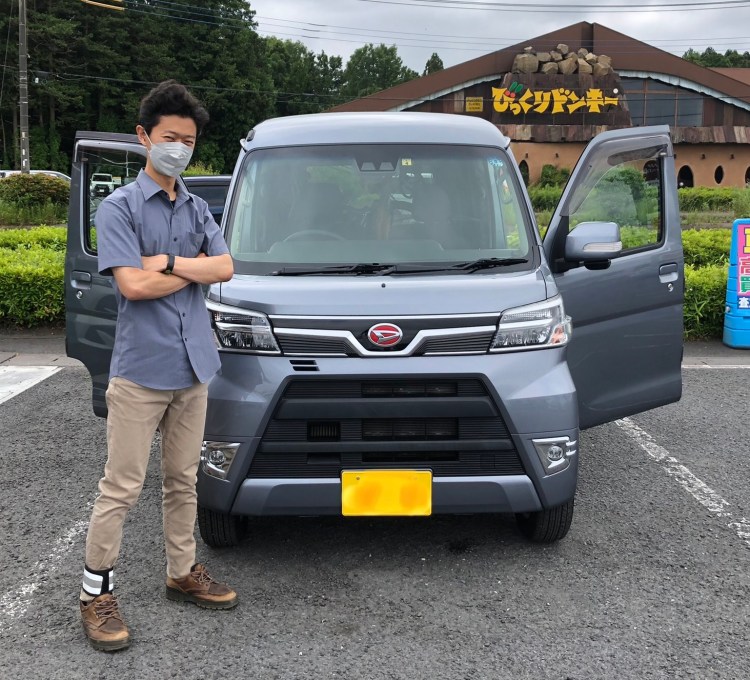
Having just passed the Japanese Driver’s License Test on my first try, our next step was buying a used car in Japan.
Here is our list of expenses to take into consideration before buying a used car in Japan:
- Cost of the Car (Total Purchase Price ¥1,725,000 – Down Payment ¥500,000 = Loan of ¥1,225,000) Monthly Payments: ¥27,900
- Cost of Insurance (Monthly Payments: ¥13,690)
- Cost of Parking (Monthly Payments: ¥5,000)
- Cost of Gas (Depends on Usage: ¥7,500)
- Cost of Maintenance (Winter Tires One Time Purchase ¥60,000)
- Annual Vehicle Tax (Biannual Payments: ¥12,500)
- Cost of the ETC (When Traveling/Depends on Usage)
Monthly Fixed Costs: ¥56,173
Choosing a Car
Our primary criteria was a Kei Car (light vehicle) with enough space in the back for us to sleep in. To accomplish this the back row of seats would need to fold down and allow us to put a semi double mattress in the back.
With this criteria our options were the Daihatsu Atari, Daihatsu Hijet, and Suzuki Every Van. After doing some research we went to several local used car dealerships in our area and checked them all out. We decided to go with the Daihatsu Atari for its flexibility of use and built in features. The Daihatsu Hijet was almost identical to the Atari except the backs seats were a bench. The bench did not have a lot of cushioning and we knew it would be uncomfortable for our passengers. The Suzuki Every Van was a contender, however when we saw how the seats folded down we lost interest. The seats folded, somewhat flat, but were quite uneven.
We looked at the online pricing for new vehicles and were interested in the Daihatsu Atari. We went to a dealership and inquired about a new vehicle. Unfortunately, it would be at least six months before we could get the car. This was primarily due to global supply chain issues. Since we wanted to travel before that, getting a used car was our best option.
We looked around online and found a local Toyota dealership that specialized in selling used cars. Later, we learned that Daihatsu was an affiliate of Toyota and that the shop carried cars from both brands.
We looked at the cars they had available and we’re interested in a Daihatsu Atari Wagon they was in stock. The Daihatsu Atari Wagon was a 2019 which was the models final year of production. There were 37,000 km on it and only one prior owner from Kobe. We asked the dealership to “hold it” for us while we completed the purchasing process.
Financing/Getting a Car Loan
Initially, one of our biggest concerns was the financing piece. We had accumulated a decent down payment for the purchase of a vehicle. However, if the vehicle we wanted was over that threshold, then we would need to finance the balance.
The salesperson we were working with at Toyota helped us complete an online application for a car loan. We were told that the company would get back to us within three business days. Since it was the weekend, we figured we’d hear back by the middle of the following week.
To our surprise we got a call a few hours later from the dealership saying that we had been approved for a five year loan with a reasonable interest rate and monthly payment.
This was shocking to us and many of our friends who are also foreigners. Typically, foreigners especially those without permanent residence status have an extremely difficult time applying for and qualifying for loans of any kind. In Japan, they are seen as a flight risk and seldom get approval. If they do get approval, they usually have very short terms and high interest rates.
We’re still not sure why we were approved. My application clearly stated that I had a one year instructors visa. However we did mention in the notes section that it could be renewed on an annual basis. We speculate that me having a Japanese last name may have played a factor in the loan underwriters decision to approve us. Whatever it was, we were grateful to have gotten approved.
Before Getting the Keys
Before getting the keys, our salesperson went over some key information with us. Regarding insurance we decided to choose an “all risks” policy that would cover both damage we do to the car and damage from external factors. It was a little more expensive than the most basic plan, but gave us piece of mind. Other additional coverages we sought were a provision that covers anyone driving the vehicle, not just the person listed on the policy. This was important for long road trips where multiple people might be driving. The additional cost was negligible and it extended coverage to other drivers of the car.
In Japan, prior to taking a car home, you have to have a dedicated parking spot for it. If you live in an apartment like we did, this means contacting the property management company and reserving a parking spot. Unfortunately for us, this meant that we had to pay an additional ¥5,000/month for a reserved parking spot. We were able to add it to our monthly rent bill.
In addition, we received a certificate from the property management company that needed to be registered with the police. In most cases, this all needs to be done prior to receiving the keys to your car.
Getting the Keys
Once we had submitted the final paperwork we were ready to pick up the car. We rode our bikes over and were able to fit them in with the back seats folded down.
Our Thought Process
Buying a used car in Japan has been one of the most life changing things we have done. With our limited window of time, we have been able to see and do so much more than if we didn’t have a car. What makes the value proposition so compelling is our ability to sleep in the car during our overnight trips. On average a night at a lower to mid tier hotel for two people would run us approximately ¥15,000/night.
Japan has over 1,000 roadside stations and numerous ETC Service/Parking Areas that can be stayed at for free. Finding a place is extremely easy as they are located throughout Japan. The only issue we’ve come across is that some of the smaller roadside stations are prone to running out of spaces. We also found out pretty quickly that this was not a fringe concept. During the summer or holidays there are many RV’s, camper vans, and regular cars that spend the night at these roadside stations and rest areas.
Final Thoughts
Wow! Things progressed really quickly. We go the keys to the car exactly 30 days after I passed the driving test. If we had to do it over again, we definitely would have shopped around a bit more to make sure we were getting a good deal. We paid about market value for our car. The Daihatsu Atari Wagon we bought from the Toyota dealership definitely gave us peace of mind. It was only two years old at the time and had around 35,000 km on it. It was also still under the original owners three year factory warranty.
Key Car Buying Tips
- Determine your usage needs
- Choose a car based on your criteria
- If you find a car you like ask the dealership to “hold it” for you
- Be ready and confident to move on a car you like (good deals can be competitive)
Best of Luck on Your Car Buying Adventure.
More to Come…
2 thoughts on “Buying a Used Car in Japan”